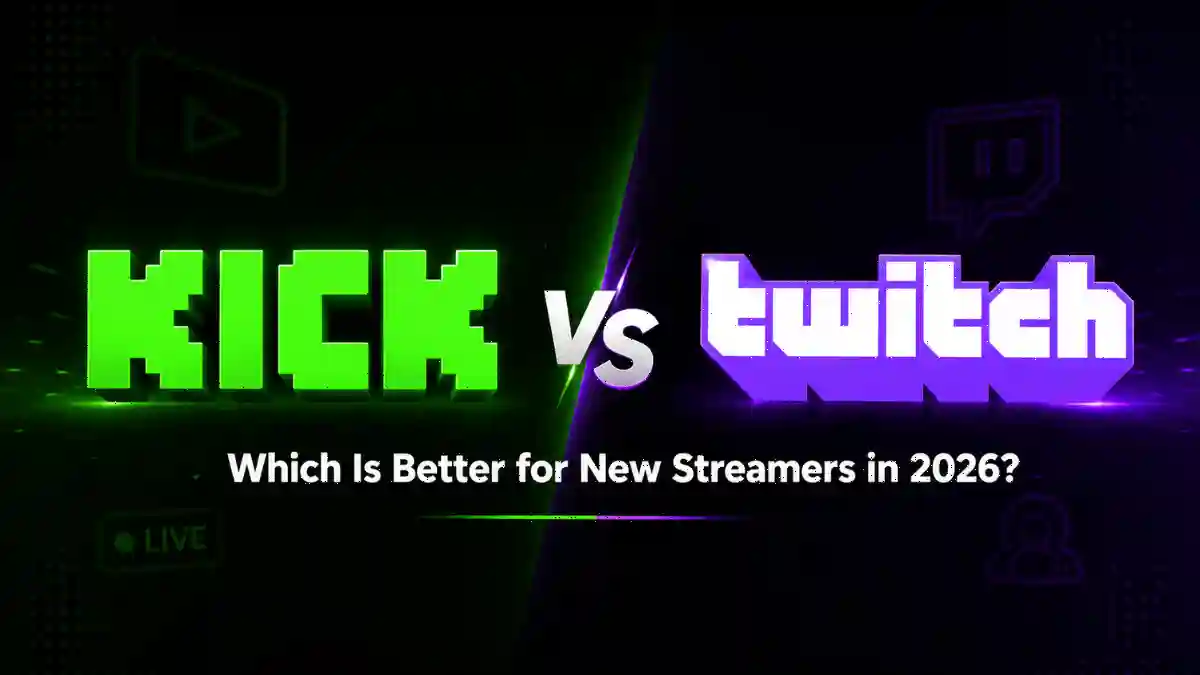
You have great game skills and fun energy, but getting viewers and actual money feels impossible on crowded platforms. New streamers often feel stuck here to choose which platform is best for him Kick or Twitch. Which one helps beginners grow faster? Which pays better? And what setup do you actually need without spending a fortune?
We cover everything here at Gaming News Lab because we know the grind. Whether you play BGMI, Free Fire, or any other game, choosing the right platform allows you to rapidly transition from having zero viewers to becoming a paid streamer. This guide compares discoverability, features, rules, real earnings, and a clear action plan.
Is Kick or Twitch Easier for New Streamers to Grow On in 2026?
Kick currently gives new streamers better early growth than Twitch because it has less competition and stronger algorithmic push for active channels. Its browse page surfaces smaller channels by viewer count, so a new creator with 5 viewers can appear right next to someone with 50.
The recommendation system on Twitch works well, though it tends to favor well-known creators who already have many followers. According to caster, Kick’s smaller but growing user base makes it easier for beginners to appear in recommendations and climb categories quickly.
Kick also rolled out its V1 algorithm to approximately 10% of users in April 2026, designed to surface content based on real engagement rather than just raw viewer count. That’s a genuine advantage for anyone starting from zero.
To reach Twitch Affiliate (the first monetization tier), you now only need 25 followers, 4 hours of total broadcast time, 4 unique stream days, and an average of 3 concurrent viewers in a rolling 30-day window. Twitch significantly lowered these requirements in June 2026, making Affiliate much more accessible for new streamers.
To enter Kick’s Affiliate program, you just need to stream for 5 cumulative hours. Kick’s Partner Program criteria are 75 average concurrent viewers and 250 followers, this is now much easier to achieve since the follower requirement was recently decreased from 1,500 to 250.
How Do Features, Tech, and User Experience Compare?
Both platforms deliver solid streaming tech, but Kick feels simpler and more creator-friendly for beginners with fewer interruptions and quick setup.
According to report, Twitch has over 240 million monthly active users in 2026, with 35 million people logging in every single day and 2.55 million watching at any given moment. It’s a proven, battle-tested ecosystem that has dominated the esports scene for over a decade.
Kick sits at roughly 100 million total users by early 2026, growing at double digits quarter-on-quarter. That growth rate matters. LiveReacting reported, Kick claimed 11% of the gaming streaming market in 2025, while Twitch’s share dropped from 71% to 54% over the same period.
Twitch offers mature tools like better clips, highlights, and extensions. Kick matches on core needs: low-latency chat, channel points, and reliable streaming. Many new streamers prefer Kick’s clean interface and lack of forced mid-roll ads, which keeps viewers happier.
For a brand-new channel with zero followers, Twitch’s 240 million users are largely irrelevant. Those viewers are already locked into the streamers they follow. Twitch’s algorithm doesn’t hand out discovery to beginners. Kick’s smaller, more connected community is actually more navigable when you’re starting out.
What About Content Rules, Community, and Brand Safety?
Kick takes a more relaxed approach to content rules compared to Twitch. This gives streamers more freedom, especially with mature or edgy games, but it can lead to a wilder community vibe.
Twitch enforces stricter brand safety, which helps attract sponsors and family-friendly audiences. This makes it safer long-term for building a professional esports brand. Kick allows more types of content, including gambling streams in some cases, which boosts variety but may turn off certain viewers.
We checked it out, and the results are really clear.
When streaming Diablo 4 exclusively on Kick, we earned $0.2371 per viewer per hour. The same game on Twitch brought in just $0.0119 per viewer per hour. That’s 19.92 times more money on Kick for identical content and effort.
Even when multi-streaming (which Kick penalizes by cutting Partner Program payouts by 50% to reward exclusivity), a ferret rescue stream on Kick still earned $0.123 per viewer per hour vs Twitch’s $0.072 despite Twitch running 8 minutes of ads per hour. Kick still came out 70.83% ahead.
| Scenario | Kick (per viewer/hr) | Twitch (per viewer/hr) | Kick advantage |
|---|---|---|---|
| Exclusive stream (Diablo 4) | $0.2371 | $0.0119 | 19.92x more |
| Multi-stream (ad-friendly content) | $0.123 | $0.072 | 70.83% more |
Kick’s current payout rates are exceptional, but their long-term sustainability is an open question. Unlike Twitch, which pays creators through ads and Turbo subscribers passively, Kick currently has no ads and compensates entirely through the Kick Partner Program. Whether those rates hold as the platform scales is something every creator should watch.
What Do You Actually Need to Start Streaming?
No need to break the bank for streaming equipment. For a basic setup, you’ll need a PC with an Intel Core i5 or AMD Ryzen 5, 8GB RAM, and an NVIDIA GTX 1060 or AMD RX 580. The one non-negotiable is your upload speed, you need at least 5–6 Mbps stable for 720p streaming, and 10 Mbps or more for clean 1080p at 60 frames per second.
Software: Download OBS Studio for free. It’s the industry standard and works on both platforms.
For Twitch, set your bitrate to 6,000 kbps maximum (that’s Twitch’s cap for non-Partners), use NVENC H.264 if you have an NVIDIA GPU, output at 1080p, 60 FPS, with a 2-second keyframe interval. Use CBR (constant bitrate) mode.
For Kick, you can push up to 8,000 kbps CBR. Important: Kick has no server-side transcoding, meaning every viewer sees your stream at the exact quality you send. Set your bitrate carefully because a 6 Mbps Kick stream will buffer for viewers on mobile data with no fallback.
Check out our streaming how-to guides and our streaming gear deals section if you’re trying to build a budget-friendly setup.
Content Rules, Community, and Brand Safety
Kick has a reputation for looser content rules, and while that’s partially true, things have tightened in 2026. In March 2026, Kick updated its Community Guidelines, adding stronger restrictions on nudity and sexual content, extreme violence, hate speech, and harmful AI-generated material (including undisclosed deepfakes).
The platform also removed gambling and casino streams from its Partner Program payouts in March 2025, meaning casino streamers no longer earn hourly partner pay.
For a gaming or esports streamer, almost everything you’d normally broadcast is fine on both platforms. The practical difference is how moderation works. Twitch runs proactive moderation with faster response times.
For brand safety, Twitch has a longer track record with mainstream advertisers and sponsors. If landing early sponsorship deals is a priority, Twitch’s brand reputation can open doors slightly faster at the beginner level.
Final Word
For most new streamers in 2026, Kick is the smarter starting choice because it delivers faster growth and better early earnings, while Twitch suits long-term scaling.
If you already have an audience on YouTube, TikTok, or a Discord server, Twitch could prove to be the best option for you, as its user base of over 240 million provides a massive platform to grow your audience and reach a wider audience with your content.
Read our full guide on how to become a successful streamer, that can be vary useful for New Streamers in 2026.
Frequently Asked Questions
Yes, Kick is generally better for beginners due to lower competition, higher payouts, and easier early discoverability.
Aim for at least 10 Mbps upload, with 15+ Mbps ideal for 1080p.
Kick pays far more per viewer and per sub. Many small streamers see 2-20x better returns depending on content. Results vary, but the split heavily favors Kick.
Start with a gaming PC or laptop (16GB RAM+), basic webcam, headset, and stable broadband.
Begin with one platform to build strong habits and audience.